
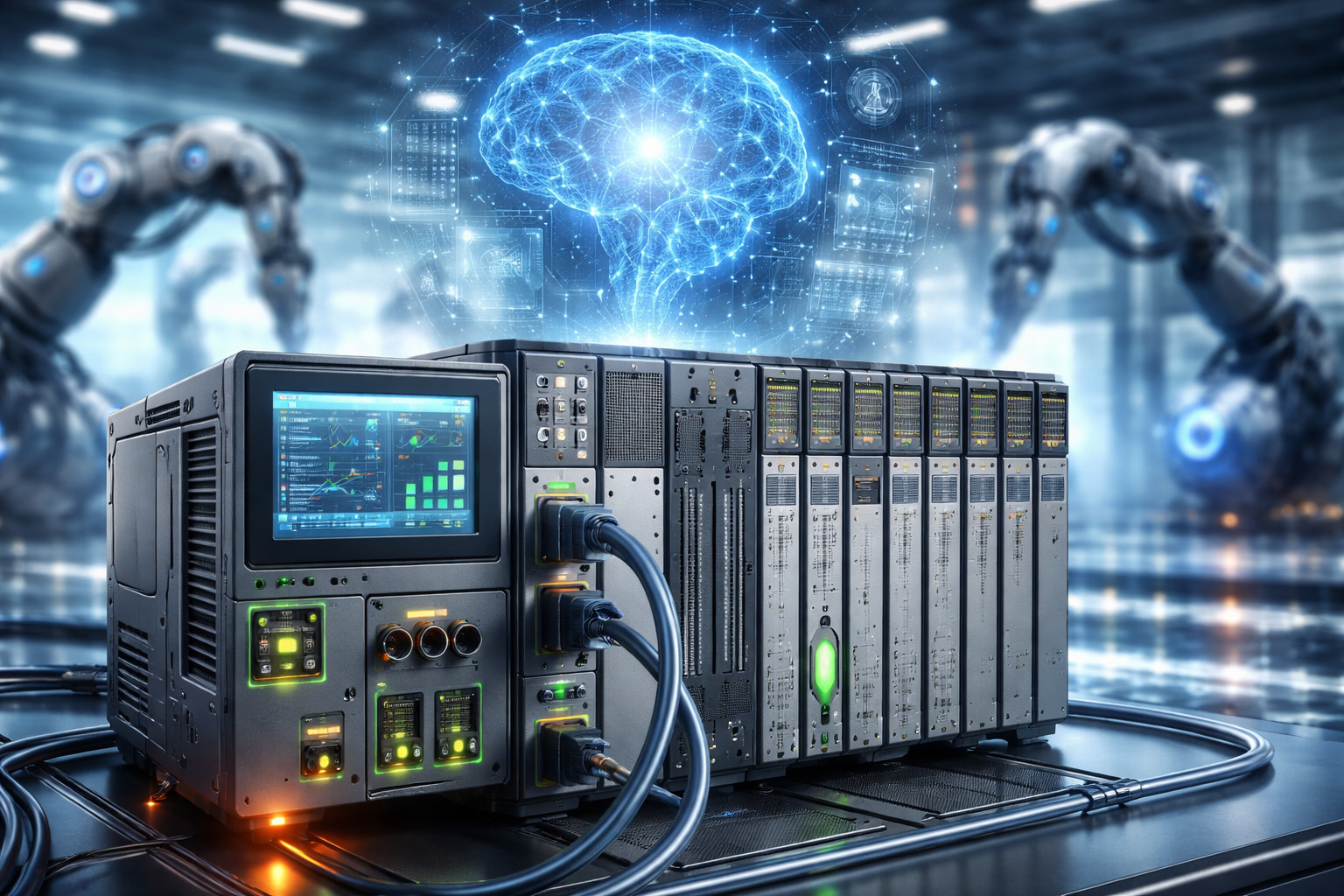
The world of industrial automation is undergoing a massive transformation. For decades, the Programmable Logic Controller (PLC) has been the “brain” of the factory floor—reliable, rugged, and predictable. However, as global markets demand higher efficiency and less downtime, the traditional PLC is getting a significant upgrade.
Enter the AI-Integrated PLC Automation System. By blending the rock-solid reliability of hardware logic with the predictive power of Artificial Intelligence, manufacturers are moving from reactive maintenance to proactive intelligence.
What is an AI-Integrated PLC?
At its core, an AI-integrated PLC is a controller that doesn’t just follow a set of “if-then” instructions. While a standard PLC executes pre-programmed logic based on sensor inputs, an AI-enhanced system uses Machine Learning (ML) algorithms to analyze data patterns in real-time.
The Core Components
- The Standard PLC Layer: Handles high-speed, deterministic tasks (e.g., stopping a motor if an emergency button is pressed).
- The AI/Edge Computing Module: An onboard processor or co-processor designed to run neural networks and deep learning models.
- Data Ingestion: High-frequency sampling of temperature, vibration, and current from IoT sensors.
Key Benefits of AI in Industrial Automation
Why bother adding AI to a system that already works? The answer lies in the limitations of human programming. There are variables in physics and machinery that are too complex for a human to code manually.
1. Predictive Maintenance (PdM)
Traditional systems use “preventative” maintenance—changing a belt every six months whether it needs it or not. AI-integrated PLCs use Predictive Maintenance. They “listen” to the vibration of a motor using an accelerometer and can predict a bearing failure weeks before it happens.
- Result: Up to 30% reduction in maintenance costs and a massive decrease in unplanned downtime.
2. Autonomous Process Optimization
In chemical processing or food production, variables like humidity and raw material quality change constantly. An AI-integrated PLC can subtly adjust PID loops and flow rates in real-time to maintain optimal output without human intervention.
3. Enhanced Quality Control
By integrating Computer Vision directly into the PLC logic, the system can identify defects on a high-speed assembly line that are invisible to the human eye, instantly diverting flawed products.
How it Works: The Integration Loop
The synergy between AI and PLC follows a continuous cycle:
| Phase | Process | Description |
|---|---|---|
| Data Collection | Sensing | The PLC gathers thousands of data points per second. |
| Analysis | Inference | The AI model identifies anomalies or optimization opportunities. |
| Action | Execution | The PLC adjusts its logic (e.g., slowing a conveyor) based on AI insights. |
| Learning | Feedback | The results are fed back to the model to improve future accuracy. |
Top Use Cases in 2026
- Smart Energy Management: AI PLCs monitor power grids in factories to shift heavy loads to off-peak hours, saving thousands in energy costs.
- Robotic Collaboration: Improving safety by using AI to predict human movement near robotic arms, allowing for faster speeds when the area is clear.
- Waste Reduction: In the textile and paper industries, AI optimizes cutting patterns to minimize scrap material.
Overcoming the Challenges
While the benefits are clear, transitioning to an AI-integrated system isn’t instant.
- Data Quality: AI is only as good as the data it receives. Clean, high-resolution sensor data is a must.
- Skill Gap: Maintenance teams need to be trained not just in electrical circuits, but in basic data science and software management.
- Legacy Systems: Many factories still run on 20-year-old hardware. Integrating AI often requires “Edge Gateways” to bridge the gap between old and new.
The Verdict
The AI-integrated PLC is no longer a futuristic concept; it is a competitive necessity. By moving intelligence closer to the “edge” (the actual machine), companies are achieving levels of precision and uptime that were previously impossible.
The goal isn’t to replace the PLC, but to give it the ability to learn, adapt, and grow with your business.