
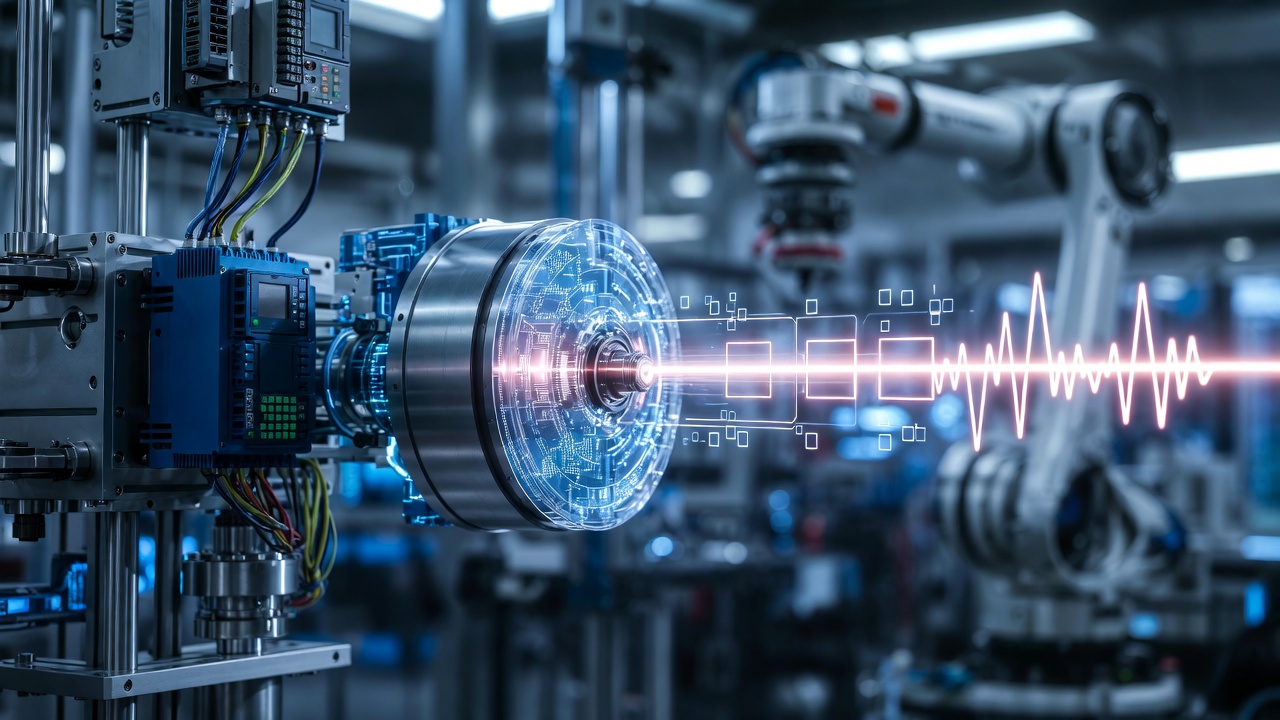
An encoder is a sensing device that provides feedback in motion control systems across nearly every industry.
These devices provide precise motion feedback, making them essential components in automation, robotics, and manufacturing equipment.
You’ll find encoders used in applications such as:
- Cut-to-length systems
- Conveyors and material handling
- Robotics and AGVs
- Packaging and labeling machines
- Plotters and printers
- Sorting, filling, and imaging systems
While they’re often hidden from view—typically mounted to motors or shafts—encoders are vital for controlling and monitoring motion accurately and efficiently.
How Encoders Work in Motion Control Systems
Encoders convert mechanical motion into electrical signals that can be read by a control device such as a PLC (Programmable Logic Controller) or counter. These signals provide real-time feedback on key parameters, including:
- Position
- Speed
- Direction
- Count or rotation
This feedback allows the control system to make decisions and send commands that drive precise movement—for example, stopping a conveyor at a specific location or adjusting motor speed based on load.

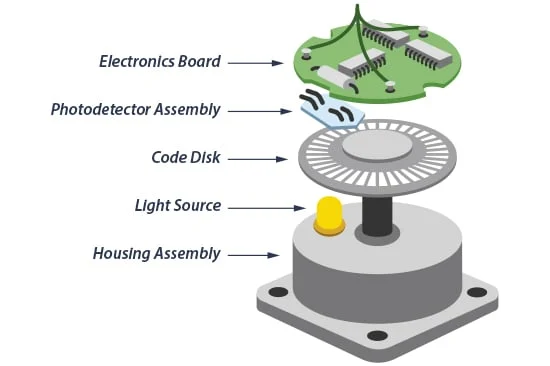
Encoders use different types of technologies to create a signal, including: mechanical, magnetic, resistive and optical – optical being the most common. In optical sensing, the encoder provides feedback based on the interruption of light.
The graphic outlines the basic construction of an incremental rotary encoder using optical technology. A beam of light emitted from an LED passes through the Code Disk, which is patterned with opaque lines (much like the spokes on a bike wheel). As the encoder shaft rotates, the light beam from the LED is interrupted by the opaque lines on the Code Disk before being picked up by the Photodetector Assembly. This produces a pulse signal: light = on; no light = off. The signal is sent to the counter or controller, which will then send the signal to produce the desired function.
Examples of Encoder Functions
In any application, the process is the same: a count is generated by the encoder and sent to the controller, which then sends a signal to the machine to perform a function. For example:
- In a cut-to-length application, an encoder with a measuring wheel tells the control device how much material has been fed, so the control device knows when to cut.
- In an observatory, the encoders tell actuators what position a moveable mirror is in by providing positioning feedback.
- On railroad-car lifting jacks, precision-motion feedback is provided by encoders, so the jacks lift in unison.
- In a precision servo label application system, the encoder signal is used by the PLC to control the timing and speed of bottle rotation.
- In a printing application, feedback from the encoder activates a print head to create a mark at a specific location.
- With a large crane, encoders mounted to a motor shaft provide positioning feedback so the crane knows when to pick up or release its load.
- In an application where bottles or jars are being filled, feedback tells the filling machines the position of the containers.
- In an elevator, encoders tell the controller when the car has reached the correct floor, in the correct position. That is, encoder motion feedback to the elevator’s controller ensures that elevator doors open level with the floor. Without encoders, you might find yourself climbing in or out of an elevator, rather than simply walking out onto a level floor.
- On automated assembly lines, encoders give motion feedback to robots. On an automotive assembly line, this might mean ensuring the robotic welding arms have the correct information to weld in the correct locations.
A compact, 2-inch blind hollow bore encoder (1) provides motion feedback on a motor. The flex mount (2) stabilizes the encoder, and the cable sends the electrical signal to the receiver.
Creating a Signal
Encoders use different types of technologies to create a signal, including: mechanical, magnetic, resistive, and optical – optical being the most common. In optical sensing, the encoder provides feedback based on the interruption of light, as illustrated in Figure 1.
A beam of light emitted from an LED passes through the Code Disk (see Figure 1), which is patterned with opaque lines , much like the spokes on a bike wheel. As the encoder shaft rotates, the light beam from the LED is interrupted by the opaque lines on the Code Disk before being picked up by the Photodetector Assembly. This produces a pulse signal: light = on; no light = off. The signal is sent to the counter or controller, which will then send the signal to produce the desired function.

Figure – 1
How a Square Wave Is Produced
As seen in Figure 1, a beam of light emitted from an LED passes through a transparent disk patterned with opaque lines The light beam is picked up by a photodiode array, also known as a photosensor. The photosensor responds to the light beam, producing a sinusoidal wave form, which is transformed into a square wave or pulse train. This pulse signal is then sent to the counter or controller, which will then send the signal to produce the desired function.
Figure 1 diagrams a typical rotary encoder. Incremental encoders can provide a once-per-revolution pulse (often called the index, marker, or reference) that occurs at the same mechanical point of the encoder shaft revolution. This pulse is on a separate output channel (Z) from the signal channel or quadrature outputs. The index pulse is often used to position motion control applications to a known mechanical reference.
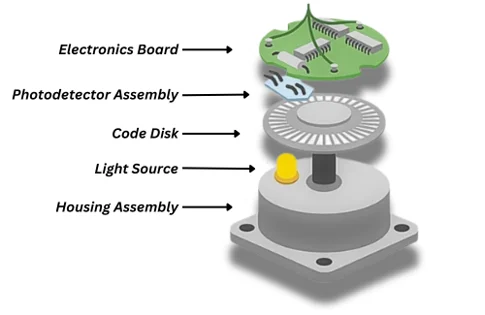
Figure – 2
Resolution
Resolution is a term used to describe the Cycles Per Revolution (CPR) for incremental encoders. Each incremental encoder has a defined number of cycles that are generated for each 360 degree revolution of the shaft. These cycles are monitored by a counter or motion controller and converted to counts for position or velocity control. Figure 2, at right, shows how the whole encoder comes together.
Application Example
Figure 3 shows one example of how an encoder is used in a typical motion control application. Cut-to-length, plotters, packaging and conveying, automation and sorting, filling, imaging, and robotics are all examples of applications that would use an encoder. The process is the same: a count is generated by the encoder and sent to the controller, which then sends a signal to the machine to perform a function.
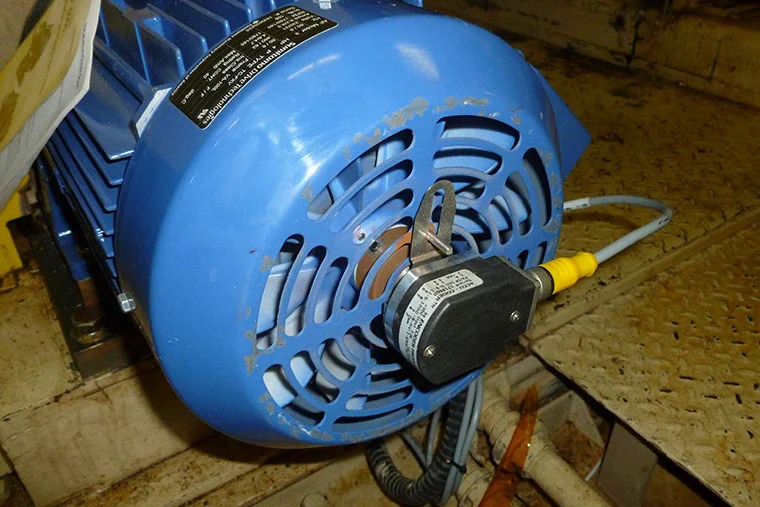
Figure – 3
Conclusion
Encoders play a critical role in modern motion control systems by transforming mechanical movement into precise electrical signals that enable accurate monitoring and control. From industrial automation and robotics to packaging, printing, and elevator systems, encoders ensure that machines operate with exact positioning, speed regulation, and directional control.
By continuously generating real-time feedback, encoders allow controllers such as PLCs to make intelligent decisions—whether that means cutting material at the correct length, synchronizing lifting systems, positioning robotic arms, or aligning elevator cars perfectly with each floor. Their ability to convert motion into measurable pulse signals, particularly through widely used optical technology, makes them one of the most reliable and essential sensing components in industrial environments.
Although often small and hidden within machinery, encoders are fundamental to achieving efficiency, precision, and safety in automated systems. Without them, consistent and accurate motion control would not be possible. In essence, encoders serve as the “eyes” of motion systems—quietly but powerfully ensuring that every movement happens exactly as intended.