
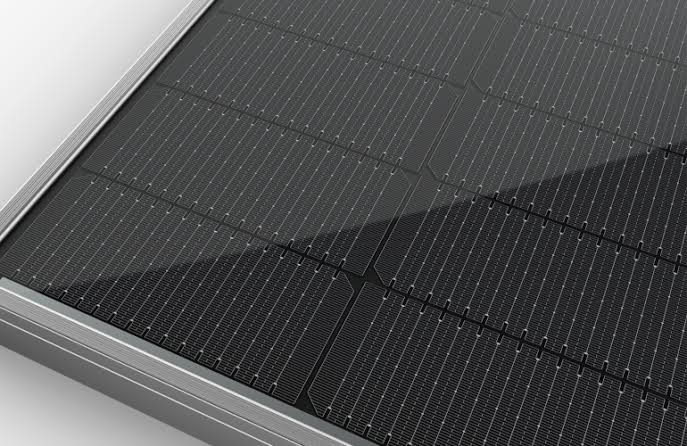
The solar photovoltaic (PV) industry is rapidly transitioning from P-Type PERC technology to N-Type TOPCon (Tunnel Oxide Passivated Contact) technology. Today, TOPCon has become the dominant choice for residential, commercial, and utility-scale solar projects because it offers higher efficiency, lower degradation, improved temperature performance, and greater long-term energy yield.
Major manufacturers such as LONGi, JinkoSolar, JA Solar, Trina Solar, Canadian Solar, and Astronergy have shifted a significant portion of their production to TOPCon modules, making it the current industry standard.
What is TOPCon Technology?
TOPCon stands for Tunnel Oxide Passivated Contact.
It is an advanced N-Type crystalline silicon solar cell technology that introduces an ultra-thin tunnel oxide layer (approximately 1–2 nanometers thick) between the silicon wafer and a heavily doped polysilicon layer.
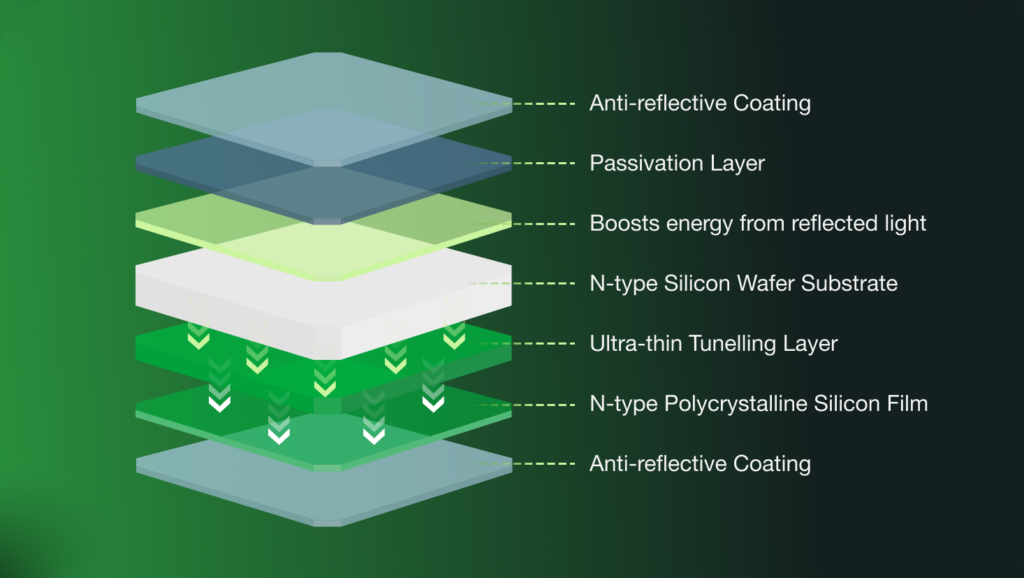
This special structure significantly reduces electron-hole recombination losses, allowing more generated electricity to be collected instead of being lost as heat.
As a result, TOPCon modules produce:
- Higher conversion efficiency
- Better low-light performance
- Lower power degradation
- Longer operational life
- Higher annual energy production
How Does TOPCon Work?
The working principle is simple:
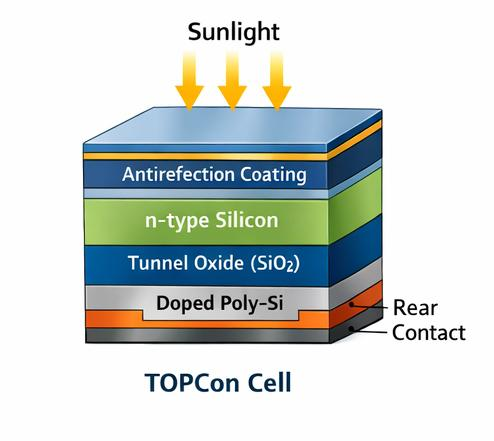
- Sunlight strikes the solar cell.
- Photons generate electrons inside the N-Type silicon wafer.
- The ultra-thin tunnel oxide allows electrons to pass through by quantum tunneling.
- The polysilicon contact selectively collects electrons.
- Surface recombination losses are greatly reduced.
- More electrical energy reaches the external circuit.
Because fewer charge carriers recombine before collection, the module achieves significantly higher efficiency than conventional PERC technology.
Structure of a TOPCon Solar Cell
A TOPCon solar cell consists of:
| Layer | Function |
|---|---|
| Anti-reflection coating | Reduces reflection losses |
| Front metal grid | Collects generated current |
| N-Type Silicon Wafer | Generates charge carriers |
| Ultra-thin Tunnel Oxide (SiO₂) | Minimizes recombination |
| Doped Polysilicon Layer | Selective electron transport |
| Rear Contact | Current collection |
Why N-Type Silicon?
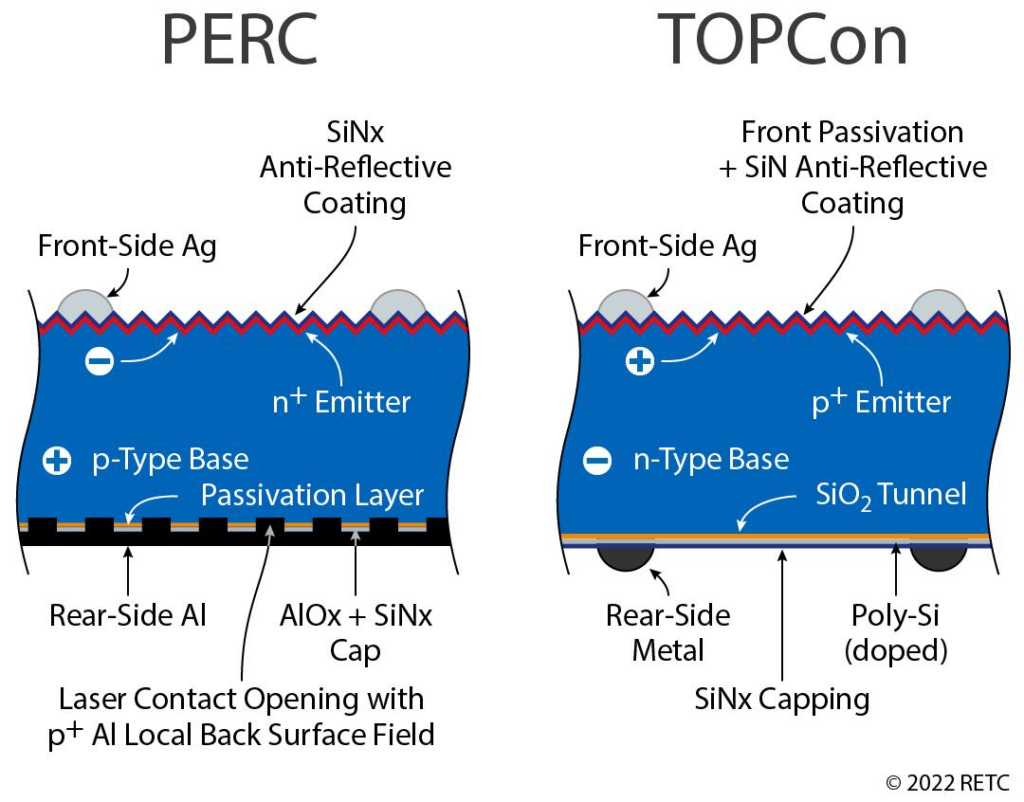
Traditional PERC cells use P-Type silicon, which suffers from Light Induced Degradation (LID) caused by boron-oxygen defects. N-Type silicon eliminates this issue because it is phosphorus-doped instead of boron-doped.
Benefits include:
- Almost zero LID
- Better resistance to LeTID
- Higher carrier lifetime
- Improved long-term stability
- Better reliability
TOPCon vs PERC Technology
| Feature | PERC | TOPCon |
|---|---|---|
| Silicon Type | P-Type | N-Type |
| Commercial Efficiency | 21–23% | 23–25% |
| Light Induced Degradation | Higher | Very Low |
| Temperature Performance | Good | Excellent |
| Bifacial Gain | 60–70% | 80–90% |
| Annual Energy Yield | Lower | Higher |
| Service Life | 25 years | 30+ years |
| Low-Light Performance | Good | Excellent |
Advantages of TOPCon Technology
1. Higher Module Efficiency
Modern commercial TOPCon modules commonly achieve efficiencies above 23%, with premium products approaching 25%.
This means:
- More electricity from the same roof area
- Reduced BOS costs
- Lower LCOE
2. Lower Degradation
Typical degradation:
- First year: around 1%
- Annual degradation: approximately 0.4%
Many manufacturers guarantee approximately 87–89% output after 30 years.
3. Better Temperature Performance
TOPCon modules generally have a lower temperature coefficient than older PERC modules.
This makes them ideal for:
- Bangladesh
- India
- Middle East
- Africa
- Southeast Asia
where module temperatures often exceed 60°C.
4. Superior Low-Light Performance
TOPCon produces higher energy during:
- Morning
- Evening
- Cloudy weather
- Winter seasons
This increases total annual electricity generation.
5. Higher Bifacial Gain
Modern TOPCon modules are mostly bifacial.
Rear-side energy gain can reach 80–90% bifaciality, depending on module design and installation conditions.
This is particularly valuable for:
- Utility-scale projects
- Floating solar
- White roof installations
- High-albedo surfaces
Manufacturing Process
Compared with conventional PERC production, TOPCon adds several advanced manufacturing steps:
- Surface texturing
- Boron diffusion
- Tunnel oxide formation
- Polysilicon deposition
- High-temperature annealing
- Metallization
- Module assembly
The advantage is that many existing PERC production lines can be upgraded rather than completely rebuilt, helping manufacturers scale TOPCon economically.
Applications
TOPCon technology is suitable for:
- Residential rooftop systems
- Commercial & Industrial (C&I) solar
- Utility-scale solar farms
- Floating PV
- Agrivoltaics
- Solar + Battery Energy Storage Systems (BESS)
Leading TOPCon Module Manufacturers
Some of the leading manufacturers include:
- LONGi Solar
- JinkoSolar
- JA Solar
- Trina Solar
- Canadian Solar
- Astronergy
- Tongwei Solar
- Risen Energy
Limitations
Although TOPCon is highly advanced, it still has some limitations:
- Slightly higher manufacturing complexity than PERC
- More expensive production equipment
- Greater sensitivity to process control
- Premium modules may have a slightly higher purchase price
However, these costs are generally offset by higher lifetime energy production.
Future of TOPCon
TOPCon is expected to remain one of the dominant commercial silicon solar technologies over the next several years. At the same time, manufacturers are developing:
- Back Contact (BC)
- Heterojunction (HJT)
- TOPCon + BC hybrids
- Perovskite-Silicon Tandem cells
These technologies aim to push commercial efficiencies beyond 28% in the future.
Conclusion
TOPCon (N-Type) technology represents one of the most significant advancements in crystalline silicon photovoltaics. By combining N-Type silicon with tunnel oxide passivated contacts, it delivers higher efficiency, lower degradation, superior temperature performance, and greater long-term energy production compared with older PERC modules.
For projects in hot climates such as Bangladesh and other tropical regions, TOPCon modules provide an excellent balance of performance, reliability, and lifecycle value, making them one of the best choices for residential, commercial, and utility-scale solar installations.
hello
okey f or that